
Your certificate of origin can be the difference between a smooth delivery and a costly border delay. Maintaining a compliant, efficient supply chain requires understanding why this form matters and the nuances of using it correctly.
What Is a Certificate of Origin?
A certificate of origin is a legal document that declares which country manufactured your goods and which country shipped them. Think of it as a passport, but for products.
Completing your COO correctly is crucial if you want your shipments to clear customs without delays. Authorities use the nationality on your form to determine whether your shipment can legally enter the country, and if so, which tariffs and duties apply.
Preferential Origin vs. Non-Preferential Origin
COOs fall into two categories.
- Preferential: These certify that your goods qualify for reduced or zero tariffs under specific free trade agreements like the United States-Mexico-Canada Agreement.
- Non-preferential: You don’t receive tariff reductions for these goods. Instead, non-preferential COOs certify the origin for general purposes like statistics, quotas or anti-dumping measures.
What Does a Certificate of Origin Do?
A complete and accurate COO directly impacts your business’s bottom line and operational speed. You can reduce landed costs by lowering duties to 0% for goods that qualify under free trade agreements.
If you hand in incomplete paperwork or a form that contains errors, you run the risk of having to pay full duty on your goods. Depending on the customs authority, you may also owe fines and have your goods seized, which can cause lengthy delays to your shipments.
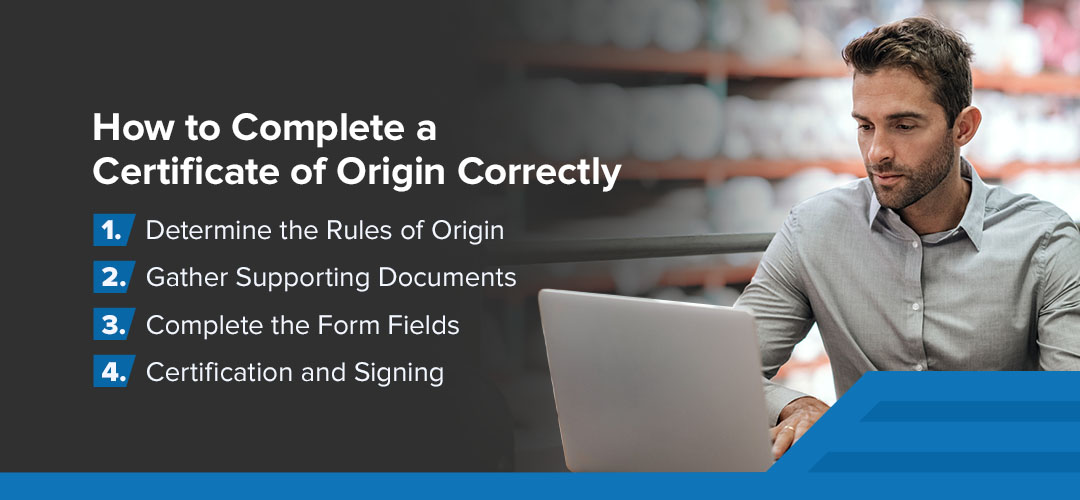
How to Complete a Certificate of Origin Correctly
Taking the time to complete a certificate of origin correctly saves you the time and cost of inaccurate forms.
1. Determine the Rules of Origin
First, assess whether your goods are wholly obtained or qualify under substantial transformation. Wholly obtained goods come entirely from one country, like corn grown in Iowa or a horse raised in Texas. They also include products made exclusively from wholly obtained inputs, such as cheese made from domestic milk, as well as scrap or waste generated from domestic production or consumption.
Substantial transformation applies when a product undergoes a fundamental change in its form, nature or character through processing or manufacturing, and that change adds value. This rule prevents companies from importing inexpensive goods, making only minor modifications and relabeling them to avoid tariffs.
There are three typical ways to show substantial transformation.
- Change in tariff classification: The finished product falls under a different Harmonized System code than the non‑originating materials used to make it.
- Value-added threshold: A significant percentage of the product’s value comes from a domestic source.
- Processing specifications: The product undergoes defined manufacturing or processing operations that qualify it as originating.
2. Gather Supporting Documents
Before filling in your form, gather the documents you’ll need for your COO, such as:
- Commercial invoices to match values and descriptions
- Bill of materials to prove the origin of components
- Precise HS codes for classification
3. Complete the Form Fields
Pay close attention to detail when completing your paperwork. Double-check that the exporter and consignee details match the legal addresses on your commercial invoice. Even a discrepancy in the Ltd. designation may trigger a hold, causing delays.
Your description of goods must mirror your HS tariff classification code. Use specific descriptions instead of internal SKUs or vague terms. For example, rather than writing “machine parts,” state their purpose, e.g, “hydraulic pumps for construction.”
Cite the correct origin criterion code to express that your good is wholly obtained or produced, or another classification.
4. Certification and Signing
The exporter needs to sign the COO to attest to the accuracy of the form. You may also need a signature from your local chamber of commerce for some goods.
Check the destination country’s signatory requirements to ensure customs officials accept the document on arrival.
Common Certificate of Origin Mistakes
Even experienced exporters can make errors, leading to rejected shipments and costly delays. Keep this checklist in mind.
- Export vs. origin: Avoid confusing the country of export, which is where the ship leaves, with the country of origin, which is where the product’s manufacturing plant is.
- HS codes: Mismatches between the HS code on your commercial invoice and the one on your COO are red flags for customs officers.
- Signatures: Failing to sign or get chamber of commerce validation when required.
- Origin certification: Using a preferential form for a non-preferential shipment, either deliberately or accidentally. Customs may view this as an attempt to get tariff benefits and zero duty.
Certificate of Origin Templates
The correct COO template will let you include all the required details for your shipment. Reliable U.S. export forms are available from sources such as Customs and Border Protection. Before completing any document, confirm you’re using the most current version for your specific trade lane. Customs authorities can reject outdated forms if they’re missing mandatory information.
COO Examples
An exporter ships auto parts manufactured in Michigan to a facility in Ontario. Canada is part of the North American free trade agreement, so the exporter can claim 0% duty. To do this, they need a preferential certificate of origin. The person who completes the origin criterion field would likely cite substantial transformation, as the company turned raw steel into a finished piston.
Now, imagine this company wants to export the same auto parts to Saudi Arabia, which does not have a free trade agreement with the U.S. That means the company would need to use a non-preferential certificate of origin. These documents typically need validation from a local chamber of commerce, which stamps the form to prove the goods are American-made for record-keeping and quotas. While the exporter must still pay the Saudi import duty, the paperwork is correct and clears customs without delays.
Choose EMO Trans for Compliance Expertise
From getting the best trade preferences for your goods to minimizing delays, an accurate and complete COO is crucial for your export operations. Working with experts who understand the complexities of global trade compliance will save you time and the cost of fines or delayed shipments.
At EMO Trans, our compliance advisors ensure all your trade documents meet the exact requirements of every country you ship to. Rest assured, your shipments are always in the best hands with the global network of vetted partners we have forged since 1965. Streamline your export processes today by requesting a free quote.